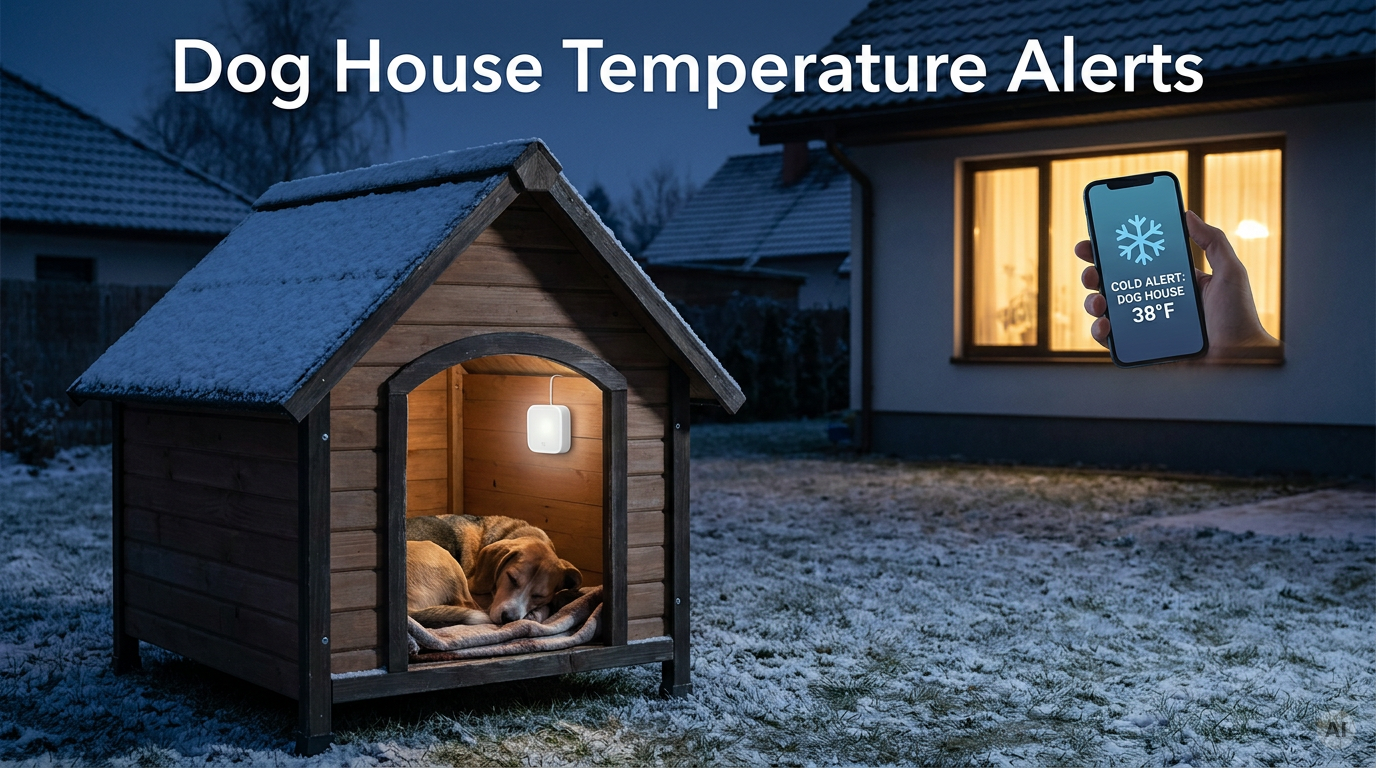
A January night, minus eight in the yard, and your dog is asleep in a dog house you can't see from bed. A Shelly BLU H&T mounted inside sends its temperature to your phone and warns you when it drops below 5 °C or climbs above 28 °C.
Overview
A clear night after a mild day: by 4 a.m. the inside of the dog house is down to 2 °C and the dog is curled up tight. In July the same box, standing in the afternoon sun, gets hotter inside than the yard around it. From your house, you see neither.
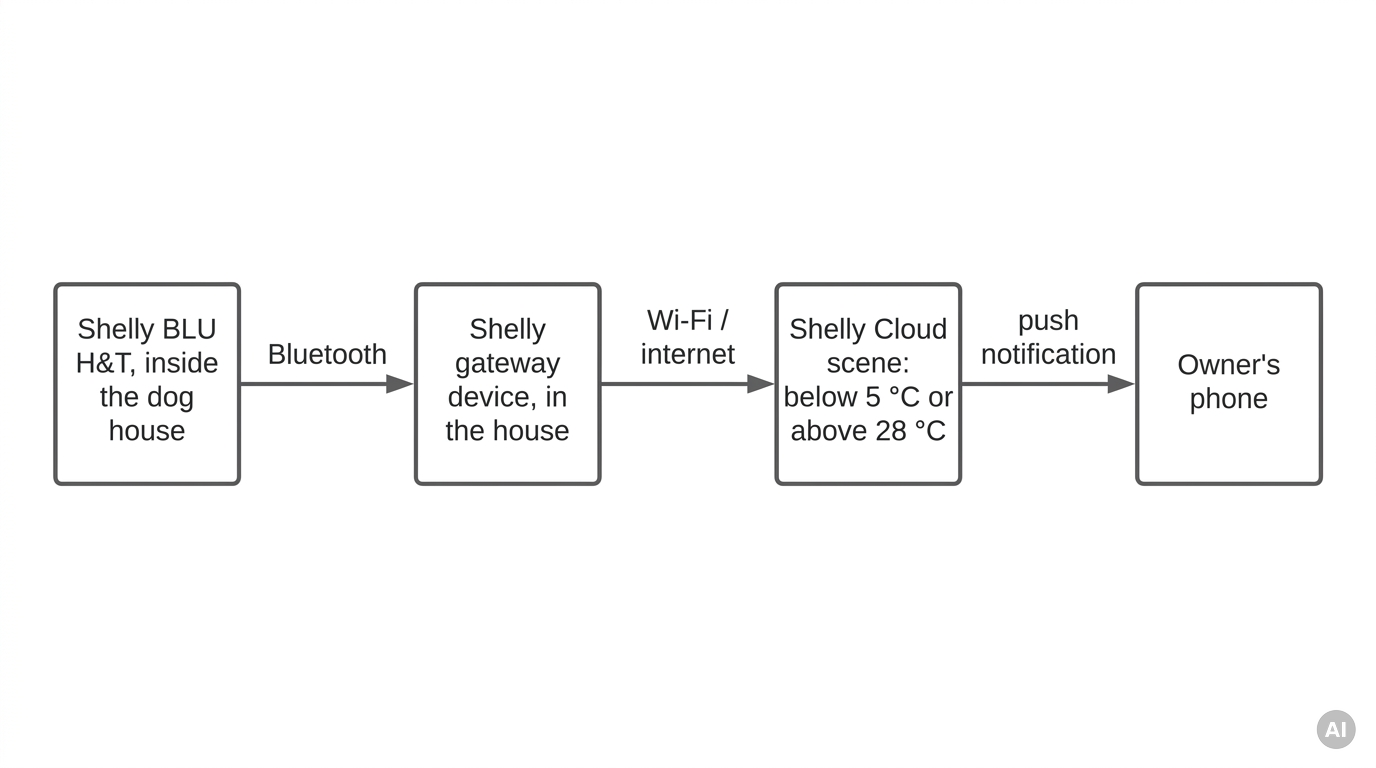
Here a Shelly BLU H&T sits inside the dog house and sends the temperature over Bluetooth to a Shelly device in your house, which acts as its gateway. Two scenes in the Shelly Smart Control app watch the reading. You get a push notification when it goes below 5 °C or above 28 °C.
Important scope note: this setup only measures and alerts. It doesn't heat or cool the dog house, and it reads the air, not the dog's health. The sensor is splash- and dust-resistant but not waterproof, and it works from −20 °C to 60 °C, so mount it inside, never on an outside wall.
Prerequisites
-
Shelly BLU H&T, mounted inside the dog house
-
A Shelly Gen3/Gen4 or Pro device in the house, or a Shelly BLU Gateway, acting as the sensor's Bluetooth gateway (range up to 30 m outdoors and about 10 m indoors; every wall shortens it)
-
Wi-Fi and internet at the gateway, so the alert can reach your phone
-
Shelly Smart Control app
Steps
-
Fix the BLU H&T high on an inside wall of the dog house, away from the bedding. Lower down, the dog's own body heat warms the sensor and the reading stops meaning anything.
-
Pick the gateway: the Shelly device closest to the yard, ideally near a window. If there's none on that side of the house, a Shelly BLU Gateway plugged in there does the job.
-
In the app, add the BLU H&T and choose that device as its gateway. Wait for the first temperature reading before you go on.
-
Create a scene called "Dog house too cold". When: BLU H&T temperature is below 5 °C. Do: send a notification. Set it to "Once", so you get one alert when the temperature crosses the limit, not one for every reading below it.
-
Create "Dog house too hot" the same way, with temperature above 28 °C.
-
Test it before the first cold night. We recommend setting the hot limit one degree above the current reading for a moment and warming the sensor in your hand. When the notification arrives, set the limit back to 28 °C.
Troubleshooting
-
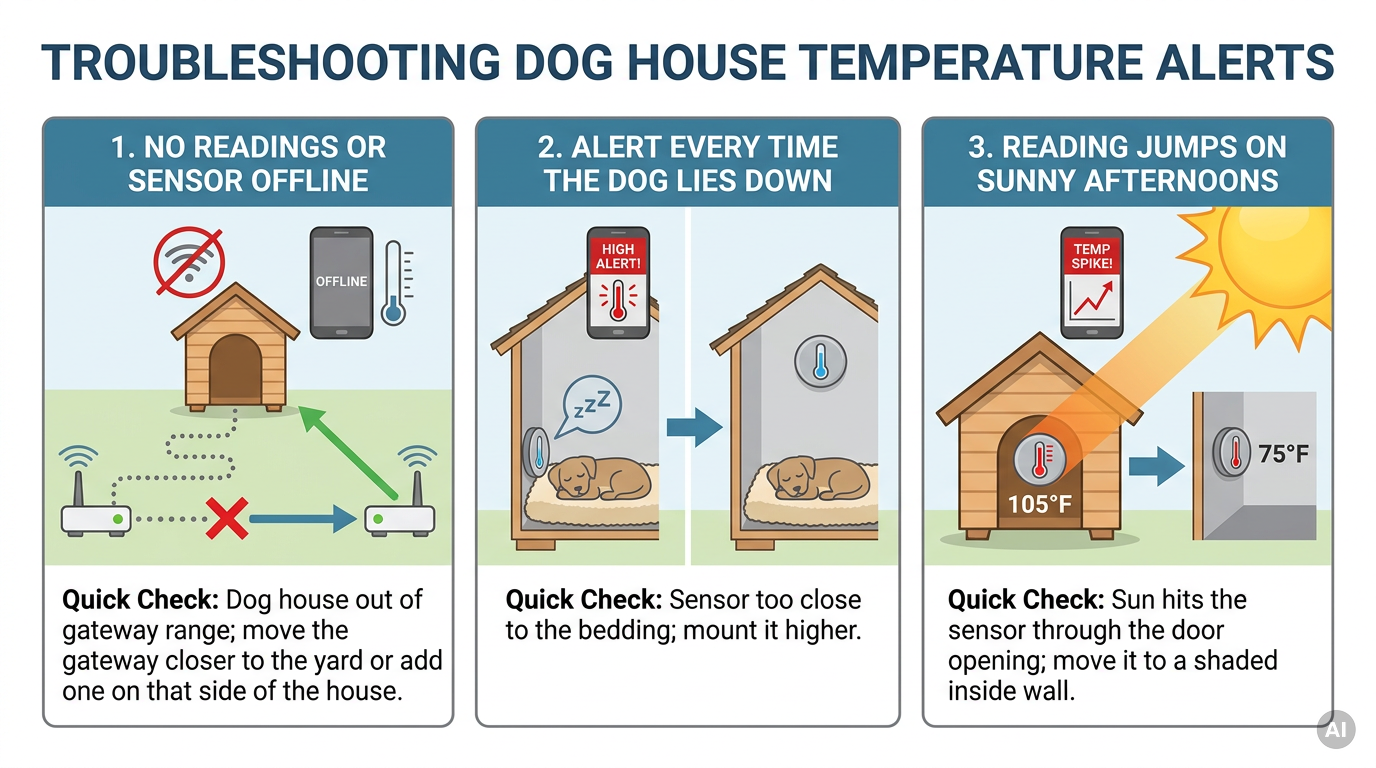
No readings, or the sensor shows offline → the dog house is out of the gateway's range. Move the gateway closer to the yard, or add one on that side of the house.
-
An alert every time the dog lies down → the sensor is too close to the bedding. Mount it higher.
-
The reading jumps on sunny afternoons → sun reaches the sensor through the door opening. Move it to a shaded inside wall.
Tips
-
5 °C and 28 °C are starting points. Puppies, older dogs and short-coated breeds need a narrower range, so ask your vet what suits your dog.
-
Cold drains coin cells faster. Check the battery level in the app before each winter; the sensor takes a CR2032.
Devices Used
-
Shelly BLU H&T
Documentation & References
-
Shelly BLU H&T — operating range (−20 to 60 °C), CR2032 battery and Bluetooth range (30 m outdoors, 10 m indoors); useful for placing the sensor and gateway in steps 1–2.
Check also:
-
Smart Control for Heater / Convector using Shelly — the same BLU H&T with a below/above pair of temperature scenes, there switching a heater; see it to make the reading switch a device.
Why It's Worth It
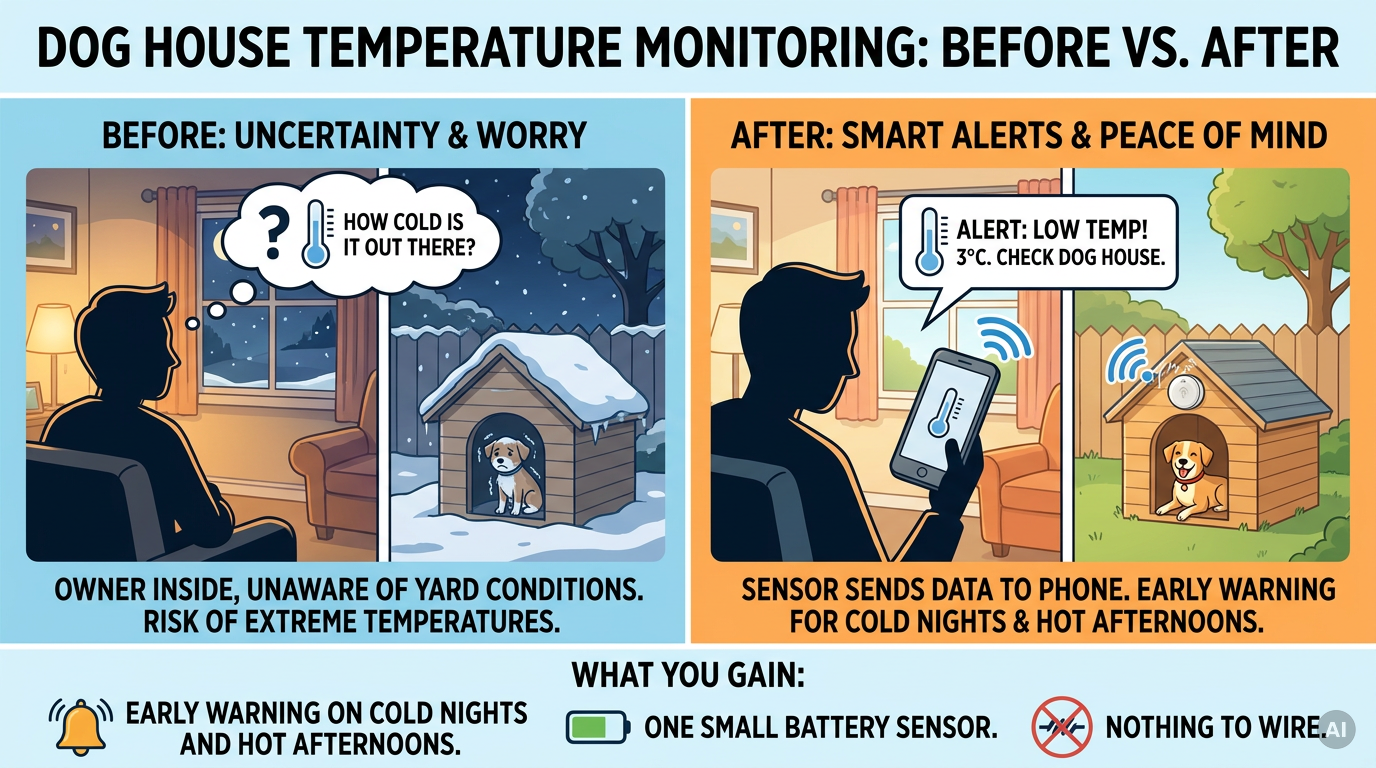
You hear about a freezing or overheating dog house while there's still time to walk out and do something about it. One battery sensor and two scenes, with nothing to wire.
Conclusion
The dog house now has a thermometer that talks to your phone. When it gets too cold or too hot inside, you get one notification and can go out and check on the dog.
--- vertical: pet-care concept: dog-house-temperature-alert complexity: basic devices: [Shelly BLU H&T] --- 


