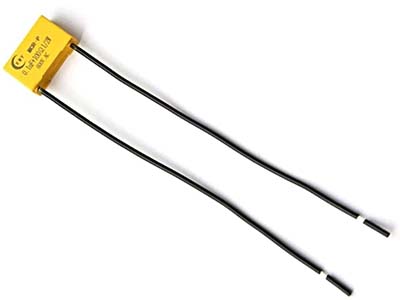
Energy absorbing circuits used to suppress voltage spikes caused by circuit's inductance when a switch opens.
2
2 Years Warranty
2 Years Warranty
This warranty covers any issues with the hardware or firmware that exist at the time of purchase or that appear within the warranty period. The warranty includes all parts of the hardware, such as the body, mechanics, and display (if applicable). However, it does not cover consumable items like batteries or accessories, as their lifespan depends on how much they are used.
The RC Snubber is a component that comprises a resistor (R) and a capacitor (C) connected in series. It effectively mitigates voltage spikes that can occur during the switching of inductive loads by providing a short-term alternative current path around the switching device, so that the inductive load is safely discharged. The RC Snubber can protect sensitive components of your Shelly device from voltage spikes and improve the overall performance and reliability of the connected circuits.
Main applications:
The RC Snubber finds common applications with inductive loads, such as:
Fans
Refrigerators
Air-conditioners
Washing machines
Tumble dryers
Transformers
LED light drivers
Other devices with electrical motors
Compatibility
If in doubt whether you need to install an RC Snubber or not, read carefully the User guide for your Shelly device. You can purchase the RC Snubber from our online shop.
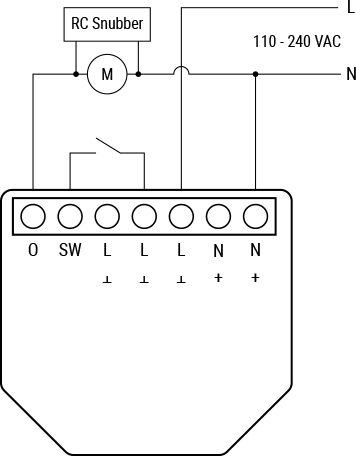
You should connect RC Snubbers in parallel to inductive loads which you intend to switch with Shelly devices. Connect the RC Snubber as close to the inductive load as possible.
Specifications
Dimension
Value
Capacitance:
0.1 µF
Resistance:
100 Ω
Power consumption:
1/2 W
Rated voltage:
600 VAC
Wiring diagram example
RC Snubber connected in parallel to an AC motor controlled by Shelly 1PM.
The Shelly RC Snubber is a component used to reduce voltage spikes caused by the switching of inductive loads, such as fans, transformers, or refrigerators. It helps to protect Shelly devices by offering an alternate path for the current to safely discharge.
Do I need an RC Snubber with my Shelly device?
You may need to install the RC Snubber if you are controlling inductive loads with your Shelly device. This includes devices with motors like air conditioners or LED light drivers. Always check your Shelly device's user guide for compatibility.
How is the Shelly RC Snubber installed?
The Shelly RC Snubber should be connected in parallel to the inductive load you are switching with your Shelly device. It's recommended to place the RC Snubber as close to the load as possible for optimal performance.
What are the technical specifications of the Shelly RC Snubber?
The RC Snubber has a capacitance of 0.1 µF, a resistance of 100 Ω, a power consumption of 1/2 W, and a rated voltage of 600 VAC.
What are the differences between the different generations of Shelly products?
Each new generation adds more power, memory, and features:
Gen 1 offers basic control;
Gen 2 (Plus Series, Mini Series, Pro Series) adds Bluetooth, scripting, and better security;
Gen 3 improves performance, adds Matter (starting from firmware version 1.6.0 or newer) and advanced monitoring;
Gen 4 offers multi-protocol connectivity, featuring Wi-Fi 6, Bluetooth, Zigbee, and Matter.
Yes, Shelly devices (except for Wave devices) operate independently without the need for a hub. They connect directly to your Wi-Fi network, and you can control them via the Shelly Smart Control app, web interface, or through integrations with platforms like Google Home, Alexa, Home Assistant and Samsung SmartThings.
What is the RC Snubber used for?
The RC Snubber can protect sensitive components of your Shelly device from voltage spikes and improve the overall performance and reliability of the connected circuits. It effectively mitigates voltage spikes that can occur during the switching of inductive loads by providing a short-term alternative current path around the switching device, so that the inductive load is safely discharged.
How do I install the Shelly RC Snubber?
To install the Shelly RC Snubber:
1. Connect it in parallel to the inductive load you intend to switch.
2. Ensure the connection is made as close to the load as possible to maximize effectiveness.
3. Follow the wiring diagram provided in the Shelly documentation for accurate installation.