Nine ways Shelly devices work around solar power: profiling a home before the install, connecting existing inverters and batteries, using surplus, keeping critical circuits on in an outage, and running off-grid cabins and campers. Each job links to a detailed step-by-step guide.
Overview
Solar panels make electricity. They don't decide where it goes. That part still falls to the people who plan, install and live with the system, and it's where most of the value is won or lost.
Shelly devices sit in that gap. They measure, switch and talk to other equipment, and they're small enough to fit into a distribution board, behind a socket, inside a shed or under a caravan seat. This article walks through nine jobs they do around solar power, grouped by when they come up. Each job links to a detailed guide.
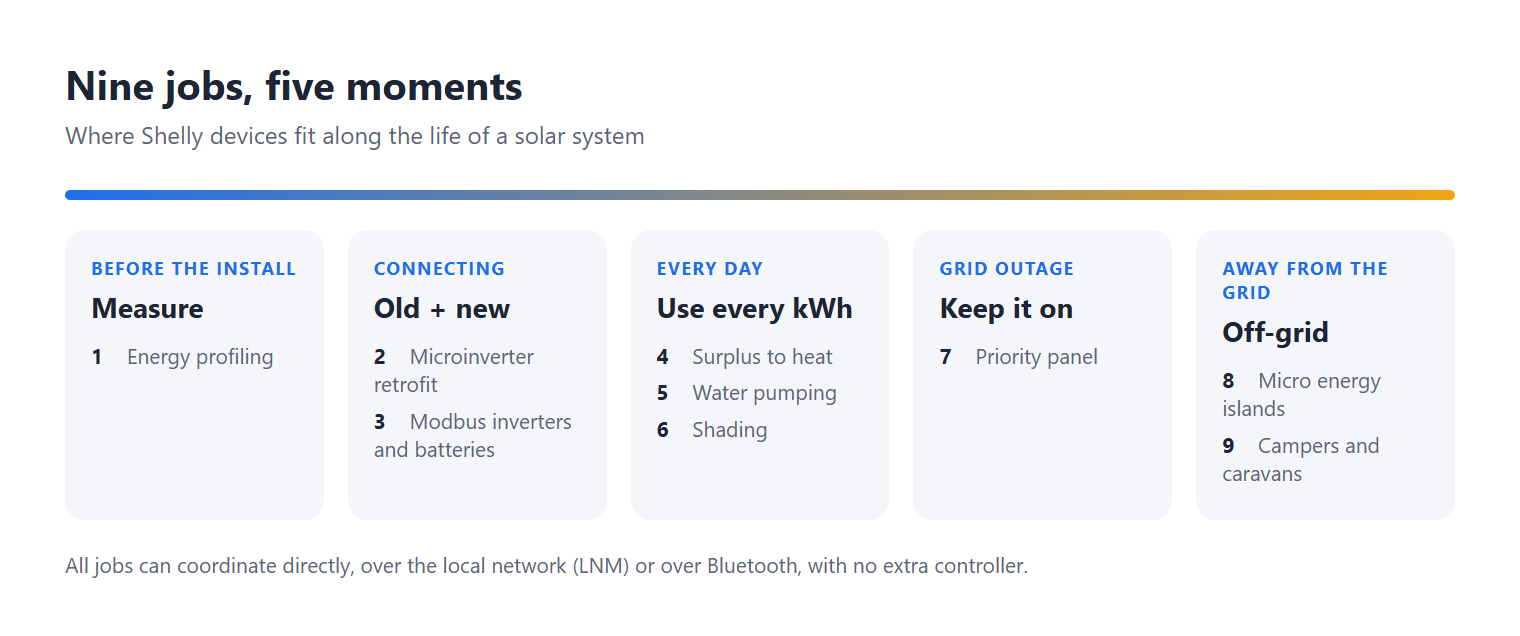
The nine jobs, grouped by the moment in the life of a solar system where they come up.
Who this is for
| If you are... | Start with |
|---|---|
| PV installer, quoting from real data and offering more than panels and a battery | Energy profiling (1), Modbus (3), surplus (4), priority panel (7) |
| Electrician looking after homes with PV, without cutting into someone else's system | Energy profiling (1), retrofit (2), priority panel (7) |
| Homeowner, still planning or building your own setup from 12 V lead-acid to 48 V lithium | Energy profiling (1), surplus (4), shading (6), micro energy islands (8) |
| Camper or caravan owner living on a battery and a roof panel | Campers and caravans (9) |
Whichever jobs you combine, the devices can coordinate with each other directly, over the local network or over Bluetooth, with no hub or third-party controller. See Coordination without a controller.
Before the install
1. Energy profiling: measure before you size
Most solar quotes start with one number: last month's electricity bill. That tells you how much the home used. It says nothing about when it used it, which is exactly what decides battery size, inverter rating and whether a heat pump or EV changes the picture.
A Shelly Pro 3EM (three-phase) or Shelly Pro EM (single-phase) clips onto the incoming supply with current transformers. No circuits are cut and nothing is rewired. From then on it records:
-
consumption at one-minute resolution
-
daily and weekly patterns, including weekday vs. weekend
-
peak demand and baseload (the power the home draws even at 3 a.m.)
The Shelly Smart Control app stores that history long term and makes it easy to review.
Detailed guides:
-
Before You Go Solar: Why Knowing Your Actual Usage Changes Everything
-
Design PV Systems with Confidence: Data-Driven Sizing Using Shelly Pro 3EM
-
Expanding Your Service Offering: Home Energy Profiling with Shelly Pro 3EM
-
Customer Acquisition Through Energy Profiling: A Channel Strategy for PV Solutions Providers
Connecting old and new
2. Retrofitting an existing microinverter install
Plenty of homes already have a few microinverters on a shed roof, or a first-generation array that the new system doesn't know about. That generation is real, but it's invisible, so the new system's numbers are always slightly off.
Put any Shelly EM or PM device on the output of the old array. Its production then shows up next to the main system, so total generation and self-consumption are counted correctly. PM relays and plugs can also switch the old array off on command, which helps when export has to be limited.
Detailed guides:
3. Bringing inverters and batteries in over Modbus
Most inverters, battery systems and charge controllers speak Modbus, the industrial standard for reading values from equipment. Shelly Pro devices with the Shelly Pro RS485 Add-on, or The Pill with an RS485 add-on, can act as a Modbus RTU client. They poll the equipment, read its registers and show the values in the Shelly app as virtual components, right next to your relays and meters. Once those values are inside Shelly, they can drive automations like any other sensor.
Two lessons from the bench
Read the plant address. Many systems serve whole-site data on a dedicated Modbus address, separate from the address of each individual unit.
If every reply looks like garbage, swap A and B. Reversed RS485 polarity is the most common fault, and no amount of baud-rate tuning fixes it.
Detailed guides:
Using every kilowatt-hour
4. Soaking up surplus instead of curtailing it
When the battery is full and nobody's using power, many systems simply turn the panels down. That's free energy thrown away.
A better destination is thermal storage. A water heater is a battery you already own, and a sand or stone heat store does the same job on a larger scale. A Shelly energy meter watches the grid connection. When export goes above a threshold you set, a Shelly Pro 1PM, an Ogemray 25A Smart Relay (Powered by Shelly) or a similar relay switches on the heating element, and switches it off again when the surplus disappears. Heat stored at noon is hot water in the evening.
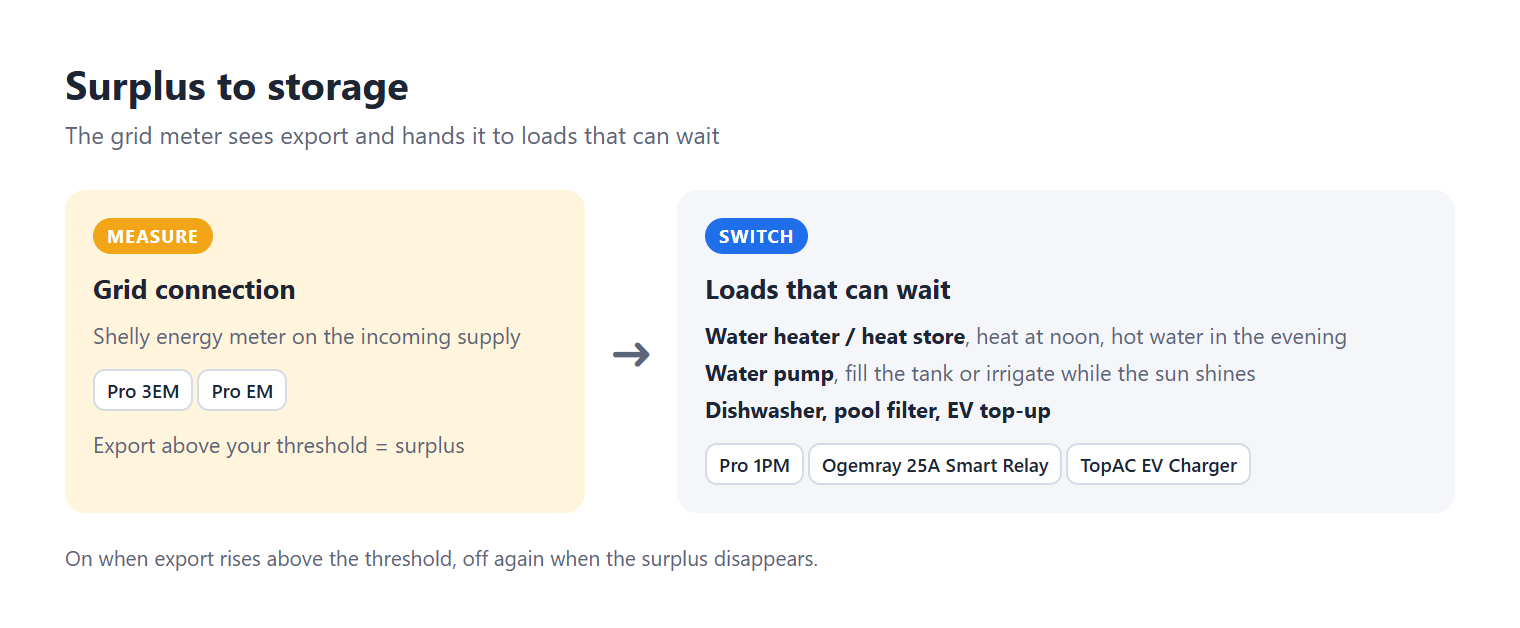
The grid meter detects export and hands the surplus to loads that can wait.
The same logic works for any load that can wait: dishwashers, pool filters, dehumidifiers, EV top-ups. The meter and the relays talk to each other directly over LNM (see Coordination without a controller).
For the car, the TopAC Portable EV Charger (Powered by Shelly) goes further than on and off: its charging current can be set from 6 to 16 A, so charging can follow the size of the surplus.
Detailed guides:
5. Pumping water while the sun shines
Pumping is one of the best uses for surplus solar, because a full tank stores energy as water. Garden irrigation, rainwater transfer and filling a header tank can all run when production is high. A Shelly relay on the pump, triggered by surplus measured at the grid meter (or by a simple time-and-sunshine schedule), does it without anyone having to think about it. The pump relay can listen to the grid meter directly over LNM.
Detailed guides:
6. Shading: protect the house instead of cooling it
The cheapest kilowatt-hour is the one you never use. In summer, closing external blinds or shutters before the sun hits a south or west wall keeps heat out of the house, so the air conditioning works less. In winter, opening them lets the sun do the heating for free.
Shelly devices that control them:
-
Shelly 2PM or Pro 2PM for blind and shutter motors
-
Dry-contact Shelly relay for shades with their own controller
-
Raex Automated Curtain System (Powered by Shelly) for curtains
-
Yihao YH002-A (Powered by Shelly) for existing chain-operated blinds
A weather station such as the Ecowitt WS90 tells them when to move, using light, UV and temperature. Your PV system goes further when the house itself needs less.
Detailed guides:
When the grid goes down
7. A ready-made priority panel
During an outage, a home battery has to cover everything on its circuits. Without priorities, the oven and the heat pump drain it as fast as the fridge does, and the battery is flat before the grid comes back.
DIN-rail relays such as the Shelly Pro 1PM or Pro 4PM switch lighter circuits directly and can be controlled remotely. For heavier circuits, a dry-contact Shelly such as the Pro 1 or Pro 2 drives a standard contactor. Build a distribution board with these on the right circuits and you can sort them into three groups.
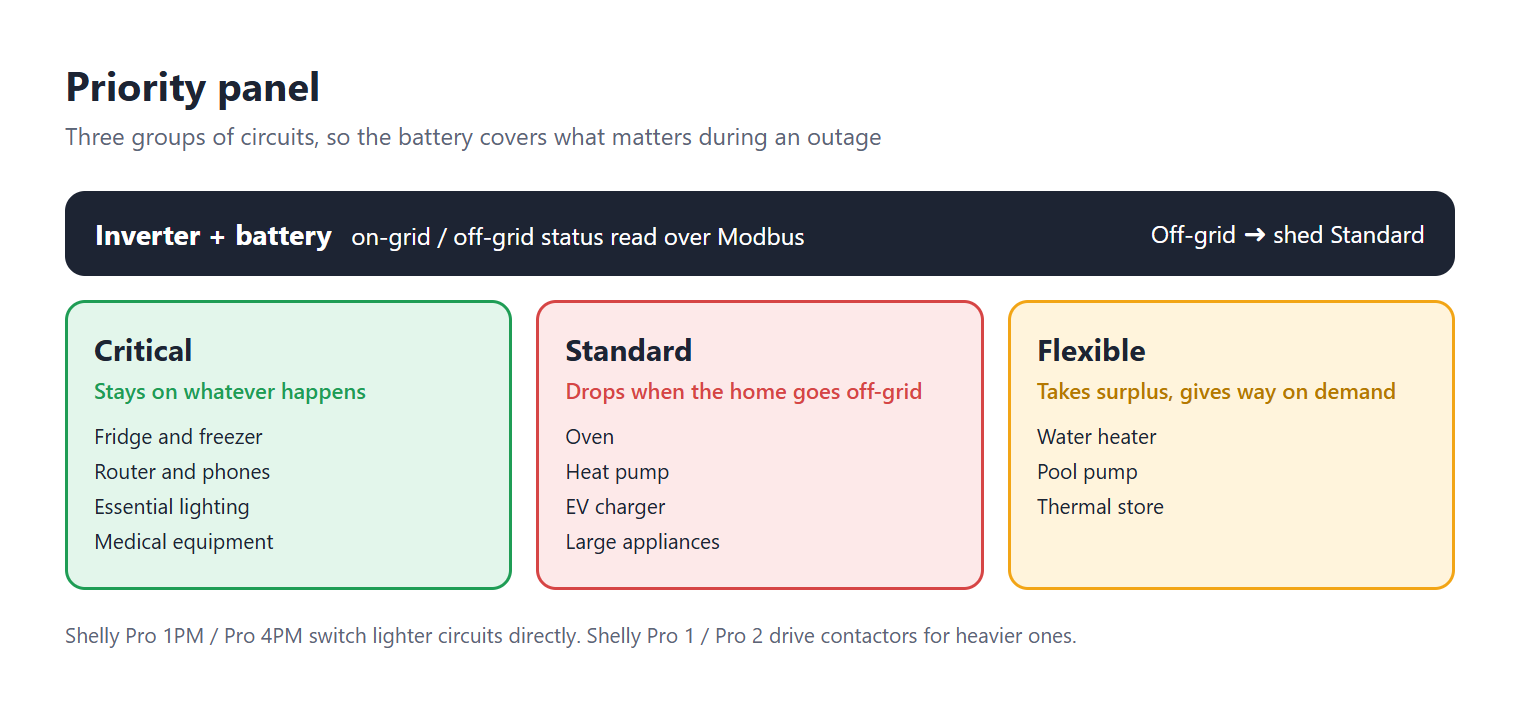
Critical circuits stay on, Standard circuits drop when the home goes off-grid, Flexible circuits take the surplus.
For electricians, this is a familiar job: a distribution board, standard DIN-rail work, circuit protection. You don't need to be a PV specialist to build it, and once it's in, you have your own view of the system so you can support the customer without touching the inverter.
If your existing inverter reports its on-grid/off-grid status over Modbus (job 3), that signal tells the panel when to shed. Over LNM, one group command then switches every Standard circuit off at once.
Detailed guides:
Away from the grid
8. Micro energy islands
Not every building is worth connecting to the grid. A garden office, a workshop at the end of a long plot, a remote cabin, a barn: for these, a small standalone system is often cheaper than trenching a cable.
The recipe is simple: a solar panel, an MPPT charge controller, a battery, and Shelly devices that run on low-voltage DC.
-
Shelly Plus RGBW PM dims LED strips and lighting on 12 V or 24 V, with power metering on each channel.
-
Shelly relays that accept a DC supply switch fans, pumps or a gate opener.
-
Shelly Plus Uni runs from the battery and reads its voltage, so you can see the charge level and switch loads off before the battery runs flat.
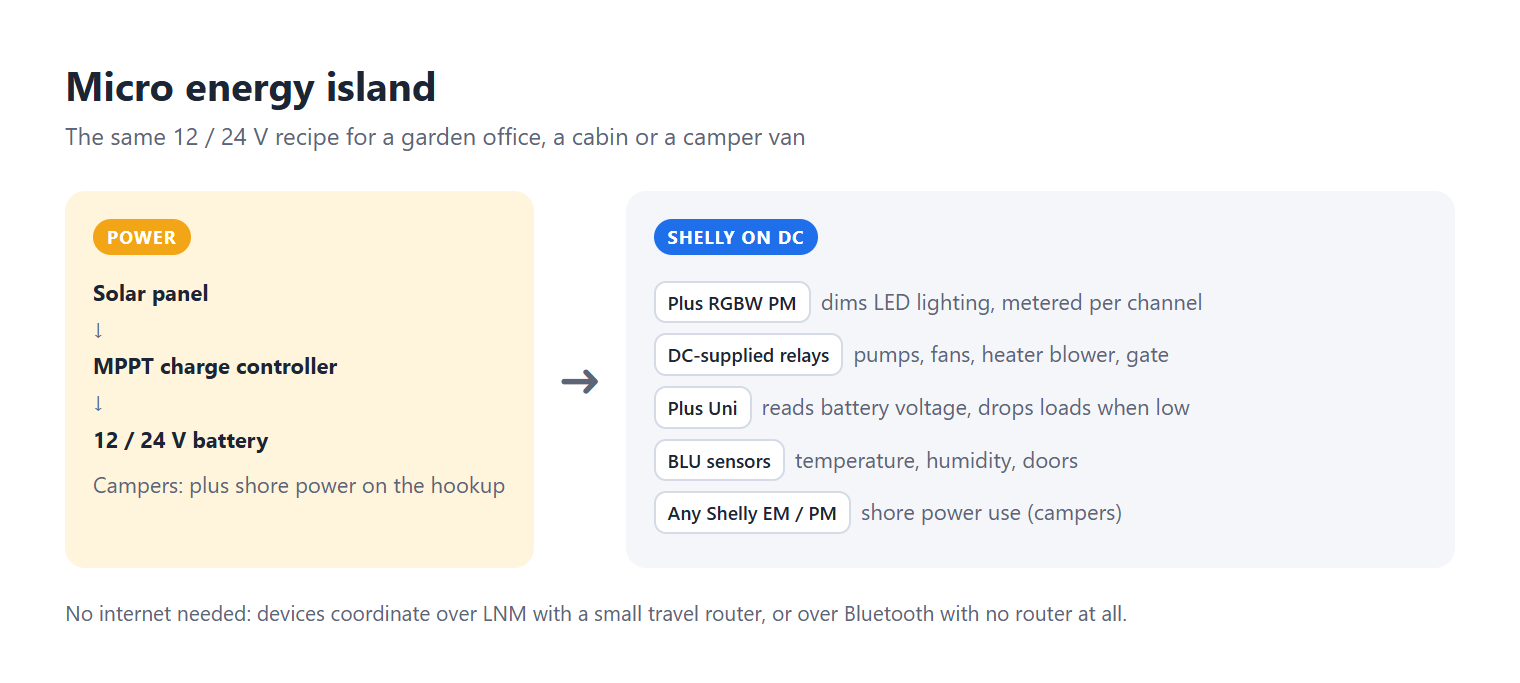
One 12 / 24 V recipe for a garden office, a cabin or a camper van.
The shed is now a controllable, monitored part of the property, with its own lights, schedules and alerts in the same app as the house. The automations run on the devices themselves, over LNM or over Bluetooth with no router at all, so they keep working without an internet connection.
Detailed guides:
9. Campers and caravans
A camper van or caravan is already a micro energy island on wheels: a roof panel, a charge controller, a 12 V leisure battery and a hookup cable for campsites. The same Shelly devices fit, and they make the battery last longer between stops.
-
Lights: a Shelly Plus RGBW PM dims interior and awning LED strips and shows how much each one uses.
-
Pumps, fans and the heater blower: DC-supplied Shelly relays switch them on a schedule or from your phone, and turn them off when the battery runs low.
-
Battery watch: a Shelly Plus Uni reads the leisure battery voltage and can drop non-essential loads at a threshold you set.
-
Comfort and security: Shelly BLU sensors report cabin and fridge temperature, humidity and open doors over Bluetooth, with no wiring.
-
Shore power: any Shelly EM or PM device on the hookup side shows what you draw on a metered pitch.
A small travel router is enough for LNM, and Bluetooth broadcast needs no router at all (see Coordination without a controller). When mobile data is available, you can check on the van from home through the Shelly app.
Detailed guides:
Coordination without a controller
This works across every job in this article: at home, in the distribution board, in a shed or on the road.
Most of the jobs above need one device to react to another: an energy meter seeing surplus and a relay switching on a heater, a grid signal and a panel shedding loads, a low battery reading and a pump switching off. That usually means a hub, a home automation server or a third-party controller sitting in the middle.
Shelly devices can do it on their own, in two ways: over the local network with Local Network Messaging, or over Bluetooth with no network at all. Either way, the logic lives on the devices, so there is no server to crash, update or forget to back up.
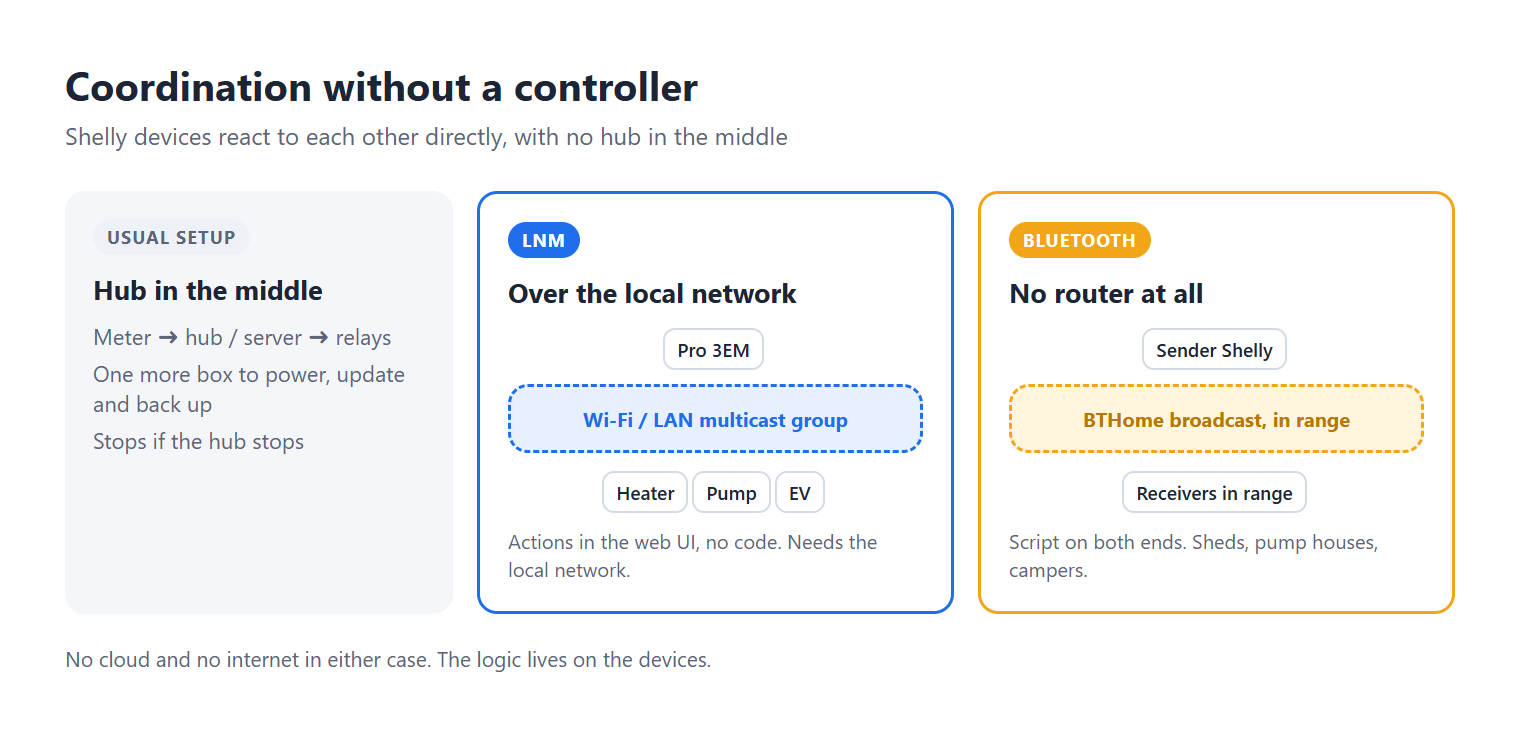
Two ways for Shelly devices to coordinate without a hub: over the local network (LNM) or over Bluetooth broadcast.
Over the local network: Local Network Messaging (LNM)
One device sends its status to a group on the local network, and every device in that group can react to it. No cloud and no internet connection are involved, only the local Wi-Fi or LAN.
-
A Shelly energy meter broadcasts grid power every measurement cycle. A relay on the water heater, a pump relay and the EV charger each listen and act on their own rules.
-
One command reaches a whole group. A single message can switch every Standard circuit in the priority panel off at once.
-
No code needed. Receivers react through Actions you set up in the web interface, or through on-device scripts when the logic gets more involved.
Important
LNM is a preview feature, available from firmware 2.0.0-beta3. The API may change in future firmware. All devices in a group must be on the same network segment.
Detailed guides:
Without a router: Bluetooth broadcast
Since firmware 2.0, a Shelly can also send its own Bluetooth broadcasts. A short script on the sender advertises a BTHome message, or a custom payload, whenever something changes: an output switches, a button is pressed, power crosses a limit. Every Shelly in Bluetooth range can pick it up with its own script and act on it.
-
No router, no pairing. It keeps working when the router restarts or was never there: the off-grid shed, the pump house, the camper van.
-
No limit on listeners. One sender can drive as many receivers as are in range.
-
Open format. BTHome is a standard Bluetooth sensor format, and payloads can be encrypted with a shared key.
Good to know
It needs a script on the sender and on each receiver.
Each broadcast lasts about 3 seconds, and changes every 1.5 seconds or slower arrive reliably. Use it for state changes and thresholds, not for fast measurement streams.
Range is the Bluetooth range between devices, so walls and metal cabinets matter.
Available on Gen3 and Gen4 mains-powered devices and on selected Gen2 devices. Not available on battery devices or on Gen4 devices in Zigbee mode.
Detailed guides:
One app, and the system you already have
All of the above ends up in the same place: the Shelly app, Shelly Cloud, or your own platform. Every Shelly device also has a fully local API (HTTP, MQTT and WebSocket), so installers and integrators can bring it into Home Assistant, a building management system or their own dashboard without depending on our cloud.
Shelly devices are designed to sit alongside inverter and battery brands, not replace them. Installers already run them successfully with Sigenergy, Victron Energy, EcoFlow and Zendure systems, and many more. If you work with another system and want to make it talk to Shelly, Modbus is usually the way in (job 3).
Devices Used
| Device | Jobs |
|---|---|
| Shelly Pro 3EM, Shelly Pro EM, Shelly EM | 1 Energy profiling, 2 Retrofit, 4 Surplus, 5 Pumping |
| Shelly 1PM, Shelly Pro 1PM, Shelly Pro 4PM | 2 Retrofit, 4 Surplus, 5 Pumping, 7 Priority panel |
| Shelly Pro 1, Shelly Pro 2 (with contactors) | 7 Priority panel |
| Ogemray 25A Smart Relay (Powered by Shelly) | 4 Surplus |
| TopAC Portable EV Charger (Powered by Shelly) | 4 Surplus |
| Any Shelly EM or PM device (meters, PM relays, PM plugs) | 2 Retrofit, 9 Campers (shore power) |
| Shelly Pro RS485 Add-on, The Pill | 3 Modbus |
| Shelly 2PM, Shelly Pro 2PM | 6 Shading |
| Raex Automated Curtain System, Yihao YH002-A (Powered by Shelly) | 6 Shading |
| Ecowitt WS90 weather station | 6 Shading |
| Shelly Plus RGBW PM, Shelly Plus Uni, DC-supplied Shelly relays | 8 Micro energy islands, 9 Campers |
| Shelly BLU sensors | 9 Campers |
Documentation & References
Tell us what you're building
Many of these jobs started with an installer, an electrician or a homeowner showing us how they'd solved something with Shelly. If you've built a surplus diverter, a priority panel, an off-grid shed, a camper setup or a Modbus bridge to an inverter we haven't tried, we'd like to see it. Share it in the Shelly community, and tell us what's still missing.


