¿Cómo funciona un sistema inteligente de control de heating?

Un sistema de heating conectado en red puede controlarse mediante una aplicación o un asistente de voz e integrarse de forma inteligente en tu hogar inteligente. Ajusta automáticamente las temperaturas, teniendo en cuenta la eficiencia y el confort de los habitantes. En resumen: si el controlador de heating reacciona de forma inteligente a los valores medidos, la programación o los escenarios, tu hogar será más acogedor y confortable, y además ahorrarás en costes de calefacción. ¿A quién no le gustaría? La buena noticia es que la mayoría de los sistemas de calefacción pueden actualizarse rápida y fácilmente con un sistema de control inteligente. Te explicamos cómo funciona y qué funciones calentarán algo más que tu heart.

Comodidad y eficiencia:
4 ventajas del control inteligente de heating

Aquí puedes ver las ventajas de los controladores de heating en el hogar inteligente.

Shelly Europe

Many smart options: Smart heating controller control

A networked heating control system ensures greater comfort and measurable energy savings. With intelligent sensors and individual schedules, the heating output automatically adjusts to your actual needs. You can then conveniently control your heating system via an app while on the move or integrate the control system into your smart home. You can then add both temperature and humidity sensors or integrate a window sensor, for example.

Smart Heating Control

More efficient ventilation

The Shelly BLU TRV is best used as a smart heating controller. If your heating controller can be controlled smartly, you have the option of setting up networked scenes. We explain how to do this below. The following example scenario makes ventilation particularly efficient: you specify in the Shelly Smart Control app that the heating in the bathroom should be switched off if the Shelly BLU Door/Window window sensor in the same room reports that ventilation is in progress. The BLU TRV obeys and automatically reduces the heating system when the window opens. This means that your heating control runs particularly efficiently and no heat is wasted.

Efficient Ventilation

Greater living comfort and better mold prevention

The Optimum Temperature varies depending on the room. While a pleasantly warm 20 to 22 degrees is usually preferred in the living room, a cooler 16 to 18 degrees is often sufficient in the bedroom. Humidity also plays a decisive role, as it influences the indoor climate and mold growth. If the air is too dry or too humid, even the ideal temperature can be perceived as uncomfortable. For living comfort and mold prevention, you couple your heating controllers with Shelly H&T Gen3 or BLU H&T temperature and humidity sensors. They precisely record the current values and automatically adjust the heating output based on the scene you have previously defined.

Living Comfort

Automatic schedules of the heating system

How easy is it to adapt the heating times to your daily routine? With Shelly: super easy. In the Shelly Control app, you can set the heating to be turned up in the morning before you get up, for example, and automatically turned down as soon as everyone leaves the house. In the evening, the heating system welcomes you back to your comfort temperature. This prevents unnecessary heating and saves energy and costs. The only thing you need to do is create the scene in the app beforehand.

Automatic Schedules

Temperature adjustment via voice assistant

Of course, you can also control your heating system directly - there are various ways to do this. You can control your heating controller in the smart home from the Shelly Control app or with a linked voice assistant. "Alexa, set the heating to 22 degrees" is enough for the helpful assistant to turn up the temperature for you. Alternatively, you can use the Shelly Wall Display + H&T to set the heating system to a comfortable temperature. It measures how warm and humid it is in the room and automatically adjusts the output according to the stored scenes. Of course, you can also control the heating controllers in your smart home directly via the Wall Display. You always have the temperature and humidity directly in view.

Voice Assistant

Smart thermostat for radiators

Now that you are aware of the numerous possibilities, we don't want to leave you in the dark about how you can make your heating smart. Converting radiators is particularly easy: to be able to control the heating controller smartly, you can simply replace your analog radiator thermostat with a networked model. To do this, unscrew the old controller and replace it with a smart heating controller, such as the Shelly BLU TRV. It networks every conventional radiator and allows you to integrate it into your smart home - because it comes with the Shelly Gateway Gen3.

Smart Thermostat

Networked control of the underfloor heating

If you want to heat your home to a comfortable temperature using underfloor heating instead of radiators, you don't have to do without intelligent heating. Shelly has simple solutions for this too. For example, the BLU TRV plus Gateway Gen3, which is also connected directly to the heating system, is suitable. Either the Shelly 1 Gen3 actuator or the Shelly 1 Mini Gen3 is used to control the heating system motor - depending on how many amps are supported. The analog thermostat of the underfloor heating system can simply be replaced by the Shelly Wall Display - and control is automatic, via app or voice assistant.

Underfloor Heating

E-heating in the smart home

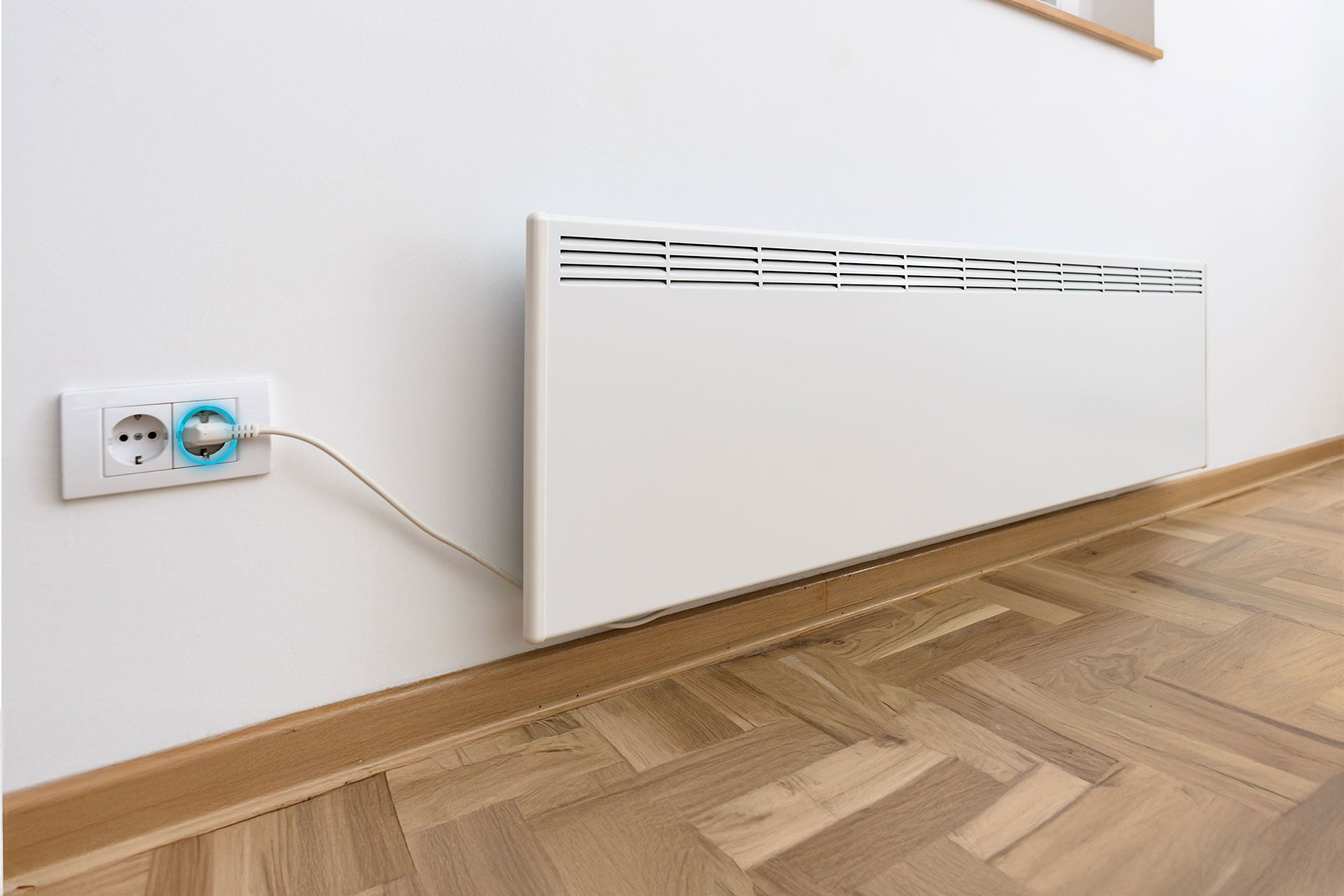
Smart control also makes sense for electric heating. After all, it consumes a relatively large amount of electricity. Intelligent heating control makes it easy to save energy. A Wi-Fi socket such as Shelly Plug S Gen3 is used for networking. They enable smart control of the connected devices via WLAN. You can then define that the heating only comes on when it gets colder than 18 degrees in the room during the day, for example. To do this, the smart socket must of course communicate with a corresponding sensor, such as the Shelly H&T Gen3. If the room in question is used as a home office, the heating only heats during working hours.

E-Heating

Control energy management in the smart home

With the help of Shelly Solutions, you can efficiently control and optimize energy consumption in the entire household. For example, you could always switch on the electric heating when the solar system is producing a lot of electricity or manage the hot water preparation on a time-controlled basis. Networking an electric heating system also makes sense in combination with dynamic electricity tariffs. Energy-intensive processes such as the operation of the electric heating can then be shifted to favorable times.

Energy Management

Heating control with the Shelly Smart Control app

Let's assume we want to set up temperature-controlled automation in the Shelly Smart Control app and use a Shelly H&T Gen3 and the Shelly BLU TRV thermostat. The two devices are first added to the app and connected within a scene. To do this, simply create a new scene and define the trigger under "If". This condition could be that the H&T Gen3 measures a temperature of less than 20 degrees in the living room. The "Then" condition would be that the Shelly BLU TRV switches on the heating. Conversely, a temperature of more than 24 degrees could trigger the heating to switch off automatically.

Shelly App

Preguntas frecuentes: controlador de calefacción en el hogar inteligente

¿Qué tan útiles son los termostatos inteligentes para radiadores?

Los termostatos inteligentes para radiadores son muy útiles, ya que aumentan la eficiencia energética y el confort del hogar. Además, son fáciles de instalar posteriormente.

¿Puedes hacer inteligente cualquier sistema de heating?

Cualquier sistema de heating puede conectarse en red. Los componentes necesarios dependen del tipo de heating en cuestión. 

¿Que es mejor: thermostat de ambiente o thermostat de heating?

Un thermostat de habitación ofrece un control centralizado de la temperatura de varias habitaciones, mientras que un thermostat de heating permite controlar de forma flexible e individual cada radiador. Por lo tanto, un thermostat de heating ofrece más ventajas. 

¿Puedes simplemente reemplazar cualquier thermostat?

La mayoría se pueden reemplazar. Los termostatos mecánicos de radiador a menudo se pueden reemplazar sin herramientas, mientras que los modelos electrónicos o montados en la pared requieren conocimientos especializados.